
Soccer Referee Hand Signals Explained for Players and Parents
NEXO FC
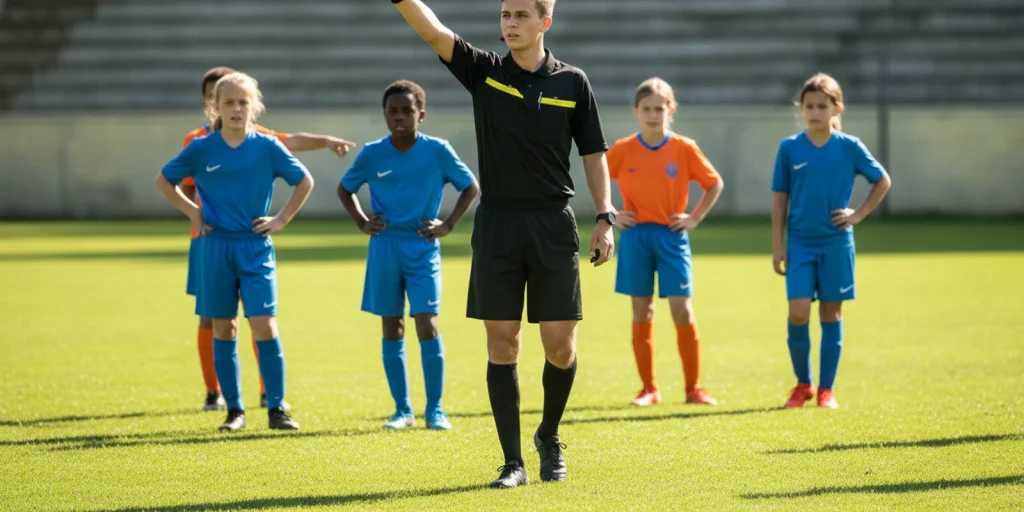
Soccer referee hand signals help players, coaches, and parents understand what happens after the whistle. Learning the common signals can make a youth match easier to follow, especially when the referee is far from the sideline or the field is noisy. This guide explains soccer referee hand signals in plain language, with practical examples of what players should do next.
Quick answer: What do the main soccer referee signals mean?
Most referee signals identify a restart, a decision, or a disciplinary action. The most useful ones to recognize are:
- One arm held straight up:
An indirect free kick. The ball must touch another player before a goal can count.
- Arm pointed in a direction:
The team indicated is usually awarded a free kick, throw-in, goal kick, or corner kick, depending on the situation and the official’s gesture.
- Point toward the penalty mark:
A penalty kick has been awarded.
- Yellow or red card held up:
A caution or sending-off, respectively.
- Assistant referee’s flag raised:
The assistant is drawing the referee’s attention to an issue, often offside or a ball out of play. The referee makes the final decision.
Signals and procedures may differ by competition, age group, and governing body. A high-school referee chart, for example, is not automatically the rulebook for every club or youth league. Players should listen for the whistle and any spoken instruction as well as watch the official.
Why do referees use hand signals?
A whistle gets attention, but it does not always explain what the call is. A signal adds visible information: who gets the restart, where play resumes, or whether a player has received a card. It can also help the referee communicate across a wide field when voices are hard to hear.
Signals support the game; they do not replace the referee’s decision. The official may use a whistle, arm movement, words, or a combination. Some decisions are clear from the direction of the restart, while others need a brief explanation from the referee or coach.
For young players, the most helpful habit is simple: stop when play is stopped, look toward the referee, and wait to see which team has the restart. Trying to decode a gesture while continuing to play can lead to confusion or an avoidable foul.
What does one arm raised straight up mean?
A referee holding one arm vertically overhead signals an indirect free kick. The arm generally stays raised until the ball is touched by another player or goes out of play. This is an important distinction from a direct free kick, because a goal cannot be scored directly from an indirect free kick. If the ball enters the opponents’ goal without touching anyone else, the restart is generally a goal kick for the defending team.
Indirect free kicks can follow different kinds of offenses, including certain goalkeeper offenses and other technical infringements. The exact reasons depend on the rules used in the competition. Players do not need to debate the original call during play. The attacking team should make sure a teammate touches the ball before trying to score directly, and defenders should remain alert until the kick is taken.
If the referee lowers the arm before the ball is touched, a player may wonder whether the kick changed. Avoid guessing. The referee may have judged that the ball was touched, play ended, or another event changed the restart. Players can ask their coach at a suitable break rather than crowding the official.
How is a direct free kick signaled?
For a direct free kick, the referee commonly points an arm horizontally in the direction the awarded team will attack. The team may score directly from the kick, subject to the competition’s laws and the position of the ball. The whistle may sound at the time of the call or be delayed briefly if the referee is allowing the team to play quickly.
A direct free kick does not automatically mean a card. The referee considers the nature of the offense and the relevant rules. Players should focus on the restart rather than trying to infer a disciplinary decision from the direction of the arm.
When the signal is made, the awarded team can decide whether to take a quick restart when permitted or wait for the referee to manage the distance of the defending players. If the referee clearly indicates that the kick must wait for a whistle, kicking early can lead to the restart being retaken or another decision. Look for the official’s instruction.
What does the referee signal for a penalty kick?
A referee who points to the penalty mark is indicating a penalty kick. The mark is inside the penalty area. This is different from a free kick elsewhere on the field, even though both decisions may follow a foul.
After the call, the referee manages the restart according to the competition’s rules. The kicker, goalkeeper, and other players have positions and timing requirements to follow. Those details can vary for small-sided, recreational, or age-specific formats, so do not rely on a general description in place of the local rules.
Players should not rush toward the ball before the referee is ready. The goalkeeper should listen for the instruction to begin, and teammates should check where they are allowed to stand. Parents can help by letting the players and official handle the moment rather than shouting conflicting instructions from the touchline.
How do referees show which team gets a throw-in?
When the ball crosses a touchline, the referee or assistant referee indicates the direction of the throw-in. The arm or flag points toward the attacking direction of the team awarded possession. This directional signal tells players which side restarts, not necessarily which player last touched the ball.
Young players often look for the official’s point and then move to take the throw. The thrower still has to follow the rules for a legal throw-in. If the referee signals the opposite way from what a player expected, the player should leave the ball for the other team and get ready to defend.
Parents sometimes see the ball touch one player last and assume the decision is obvious. From the sideline, the angle may hide a deflection or the referee may have seen something different. The signal communicates the decision; it is not an invitation for players or spectators to argue it.
What are the goal kick and corner kick signals?
When the attacking team last touches the ball before it crosses the defending team’s goal line, and no goal is scored, the restart is generally a goal kick. The referee or assistant indicates the goal-area direction. When the defending team last touches the ball before it crosses its own goal line, without a goal, the restart is generally a corner kick. The official points toward the corner area.
The two signals can be easy to confuse when the ball moves quickly near the goal. A practical cue is to watch the direction the official indicates and then check which team is preparing to restart. Players should not assume the call from where the ball landed; a deflection can change who touched it last.
Restart locations and details can be modified in youth formats. Coaches should explain the local rules before the game, particularly for younger age groups, where field dimensions and restart procedures may not match an adult match exactly.
What does a referee’s advantage signal mean?
If a foul occurs but the fouled team has a better immediate opportunity by continuing to play, the referee may allow play to continue. The referee commonly extends both arms forward and may call ‘play on’ or ‘advantage.’ The exact gesture can vary, so listen as well as watch.
Advantage does not mean the referee missed the contact or decided no foul happened. It means stopping play right away could hurt the team that was fouled. Depending on what happens next and the competition rules, the referee may return to the original offense if the expected advantage does not develop.
Players should continue only when they understand that play is live. If they hear a whistle, they must stop. A coach can help a player learn to keep awareness after contact: find the ball, notice whether a teammate has space, and respond to the referee rather than automatically stopping or appealing.
How is offside shown by the referee and assistant referee?
Offside is often signaled first by the assistant referee, who raises a flag to attract the referee’s attention. The referee may then whistle and indicate the location for the indirect free kick. The assistant’s flag is a signal to the referee, not by itself the final restart instruction. The referee decides whether to stop play.
After an offside decision, the assistant may hold the flag at different heights to indicate an area of the field, depending on the competition’s officiating guidance. Players should not try to interpret a raised flag as a complete explanation while play is still developing. Wait for the whistle and referee’s signal.
Offside decisions involve a player’s position and involvement in play at a particular moment. A player is not penalized simply for standing in an offside position; the applicable law considers whether the player becomes involved in active play. The specific law and any youth modifications govern. Coaches can explain those details with age-appropriate examples during practice.
What do yellow and red cards mean?
A referee holds up a yellow card to show a caution and a red card to show a sending-off. The referee may record the player and explain the reason. A card is a formal disciplinary action, not simply a warning from the sideline.
Rules about cautions, dismissals, substitutions, and whether a team can replace a player after a red card depend on the competition. Some youth leagues use modified procedures. Players and parents should check the league rules instead of assuming every adult procedure applies.
If a player receives a card, the player should follow the referee’s direction and let the coach manage any questions. Teammates should keep playing within the rules. Parents can model calm behavior by not confronting the official or directing criticism at a child.
How do referees signal a goal, substitution, or end of play?
To confirm a goal, a referee typically whistles and points toward the center of the field, where play will restart. The signal indicates that the goal counts and the teams will prepare for a kickoff. If the referee does not signal a goal, players should not restart on their own; the official may be checking whether the ball fully crossed the line or whether another offense occurred.
Substitution procedures are not identical in every competition. The referee may acknowledge a substitution request and direct players when the change can happen. The assistant referee may also use a flag to notify the referee. Players should wait for permission before entering or leaving the field, following the rules for their match.
At the end of a half or match, the referee uses a whistle to stop play. There is no single gesture that every youth competition uses in exactly the same way to communicate time. Players should continue until the whistle and follow the official’s instruction, even if they think time has expired.
What should players do when they see a signal?
A useful response is a short routine:
- Stop and listen.
A whistle usually means play has stopped. Do not kick the ball away or keep playing after the official has ended the action.
- Look toward the referee.
Identify the direction or gesture before moving into position.
- Check the restart.
Notice which team has possession and whether the referee is asking players to wait.
- Follow the local rules.
A coach can clarify age-group modifications before the match, rather than during a dispute.
- Return to the game.
Once the restart is clear, focus on the next play instead of replaying the call.
Players can ask a respectful, brief question when the moment allows. They should not surround the referee, shout over the whistle, or demand an argument. A calm question such as “Which team has the restart?” is more useful than an accusation. For younger players, the coach is usually the right person to seek clarification.
What should parents watch for from the sideline?
Parents can follow the match more easily by watching for three things: the whistle, the referee’s direction, and the assistant referee’s flag. The assistant can help with balls out of play and other decisions, but the referee remains responsible for making the match decision. A flag may be raised and then lowered if the referee chooses not to stop play.
It is normal for two people to see a close play differently. The parent’s angle, distance, and view of a deflection may differ from the official’s position. Rather than trying to referee from the sideline, support the child’s effort and let the players respond to the decision.
That approach supports a positive match environment. NEXO’s published values emphasize discipline, respect, effort, joy of the game, collective leadership, and family culture. Families exploring a development setting can learn about NEXO FC competitive youth soccer or read about the club’s approach to NEXO Tots for ages 2–5.
Why can the signals look different from one game to another?
Soccer is played under rules set by governing bodies, and youth leagues may adjust parts of the game for their age groups. High-school competitions, club leagues, tournaments, and small-sided programs may use different officiating instructions or modifications. The basic meaning of many common gestures is familiar, but the exact mechanics and restart details are not guaranteed to be identical everywhere.
The National Federation of State High School Associations publishes an official soccer signal chart for its context. It is a useful visual reference, but families should use their own competition’s rules when a local procedure differs. See the NFHS official soccer signals chart.
Do not treat a signal chart as a complete rulebook. A chart shows how an official may communicate a decision; it does not cover every circumstance, youth modification, or judgment call. When a question matters for a team, ask the coach or league administrator which rules are in force for that season.
How can players learn the signals without memorizing everything?
Players do not need to study a long list before they can enjoy a match. Start with the signals that affect the next action: free kick direction, indirect free kick, throw-in direction, corner kick, goal kick, penalty kick, and cards. Review one or two during practice, then connect each signal to what the team should do.
For example, when the referee raises one arm, a player can remind teammates that the free kick is indirect and they need a second touch before a goal can count. When the official points toward the corner, defenders can organize and attackers can prepare for the corner kick. Practical context makes the signal easier to remember than a list of definitions.
Coaches can also explain where players should stand during a restart and what to do if the referee asks them to wait. That turns the signal into a decision-making cue: recognize the call, find your role, and get ready for the next phase of play.
How can you read a signal during a fast match?
In a close play, it is easy to notice only the whistle or only the raised flag. Use the full sequence instead: watch who signals, listen for the whistle, then look at the referee’s direction and the players’ response. That order helps distinguish an assistant referee’s alert from a decision to stop play.
A ball crosses the sideline after a deflection
Two players challenge near the touchline and the ball rolls out. One team may immediately point toward its attacking end, while the other team does the same. The referee or assistant indicates the restart direction. The player taking the throw should use that decision and get ready; teammates should move into useful positions rather than continue arguing about the last touch.
If the official’s point is difficult to see, a player can pause and check with the referee before picking up the ball. That is especially helpful when the players are young or the game is noisy. The aim is not to challenge the official but to make sure the right team restarts.
An assistant raises a flag while an attack continues
A flag may go up for a possible offside offense, but the referee may not yet have whistled. Players should keep playing until the referee stops the match. If play is stopped, the referee’s decision and signal tell the players where the restart is. Stopping simply because a flag appeared can leave a player out of position if the referee decides to allow play to continue.
The attacking player should keep competing fairly, and defenders should continue to defend. Parents can wait for the whistle before reacting. This is a useful example of why the referee’s signal, rather than a single glance at the assistant, governs what the players do next.
A player is fouled but the referee lets play continue
Suppose a player is clipped but a teammate collects the ball in space. The referee may extend the arms and call advantage so the team can continue its attack. The player with the ball should keep playing if there is a useful option. Teammates should not stop to appeal, and the opponent should not assume the referee failed to see the contact.
If the attack breaks down immediately, the official may stop play and return to the original foul when the rules permit. Players should not decide on their own that a free kick is coming; the next whistle or instruction makes the decision clear.
A free kick is awarded near the goal
The referee points in the attacking direction. Before taking the kick, the player should check whether the signal shows an indirect free kick and whether the referee wants a whistle before play restarts. If the arm is held upright, teammates should arrange for a touch before a shot can count. If it is a direct free kick, the team may have a different scoring option, subject to the official’s instructions.
Defenders should listen for whether the referee is managing the restart. They should not assume that every free kick allows them to delay or that every kick must wait for a whistle. The official controls the restart, and the players need to respond to the specific situation.
A player sees a card and wants to know what happens next
A yellow or red card draws attention, but the card alone does not explain every consequence for a youth match. The player should follow the referee’s direction, and the coach should manage questions about substitutions or the local disciplinary procedure. Teammates should focus on their positions and wait for the referee to restart play.
Parents can avoid adding confusion by not calling out a different rule from the touchline. If the procedure is unclear, the coach can check the league’s rules at the next appropriate pause. This keeps the discussion away from the player during a high-pressure moment.
What can a family ask before the season?
Families do not need to learn every law to understand how a match will run. A few practical questions can establish expectations before the first game:
- Which competition rules apply to this age group?
- Are there local changes to field size, player numbers, substitutions, or restarts?
- Who should a parent contact if a rule or procedure needs clarification?
- Are players encouraged to ask the referee brief questions, or should they direct questions to the coach?
These questions help parents support the child without turning the sideline into a second officiating crew. They also help players know what is expected before a stressful moment occurs. Coaches can introduce the key signals during training and explain how a restart affects the team’s shape.
For families still learning the game, it can help to focus on just one new signal at each match. One week, notice throw-in direction; another week, look for the raised arm on an indirect free kick. Over time, the gestures become part of the match rather than something to decode from scratch.
What can a signal tell you, and what can’t it tell you?
A signal usually communicates the decision or restart, not the whole explanation behind it. A point in one direction tells players which team has a restart; it does not describe every detail the referee observed. A raised arm identifies an indirect free kick, but not necessarily why it was awarded. A card identifies a disciplinary action, but the referee may need to speak to the player or coach to clarify what happens under that competition’s rules.
The whistle also has a role. It can stop play, authorize a restart when the referee has required one, or draw attention to a decision. Whistle volume or number of blasts should not be treated as a universal code for the type or seriousness of every call. Listen for words and watch the official’s gesture rather than trying to decode a pattern from sound alone.
Some moments do not need a large gesture. For example, a referee may use a brief motion or verbal instruction to manage player positions. The absence of a dramatic signal does not necessarily mean there was no decision. If play continues, players should stay engaged; if the referee stops play, they should look for the direction and instruction that follow.
Signals are also not a promise that the same decision will occur in every similar-looking situation. The official judges what happened in the specific play. A player may see contact but not the angle, timing, or context that the referee sees. It is better to respond to the present call and ask a calm question later than to compare it loudly with an earlier moment.
For a player, the practical takeaway is to use signals as information for the next action, not as a reason to stop thinking. Identify the restart, communicate with teammates, and get into position. For a parent, the same approach keeps attention on the child’s effort and development rather than turning each call into a debate.
Common misunderstandings about referee signals
Does a referee pointing one way always mean a free kick?
No. Directional signals can communicate the team awarded a restart, including a throw-in or other restart. Use the context of the play and the official’s words or whistle to understand what is happening.
Does an assistant referee’s raised flag automatically stop play?
Not necessarily. The flag alerts the referee, who decides whether play should stop. Players should continue until they hear the whistle or receive a clear instruction to stop.
Does a raised arm always mean an indirect free kick?
A straight arm held overhead is the common indirect-free-kick signal, but context matters. Officials may use other gestures while communicating. Wait for the whistle and any spoken instruction before deciding what the restart is.
Can a referee change a decision?
An official may correct or clarify a decision before play restarts, subject to the competition’s rules. Players should not restart until the referee indicates that play is ready to continue.
Where can I check the exact youth rules?
Ask the coach or league for the current competition rules and age-group modifications. A national or high-school signal chart can be informative, but the local rules determine how the match is administered.
Understanding a few common signals helps players react calmly, parents follow the match, and everyone keep attention on learning and enjoying the game.
Categories
NEXO FC
Find your player's next step
Four ways to play at NEXO FC, all led by the same coaching staff.