
Game Intelligence in Soccer: How Kids Learn to Read the Game
NEXO FC
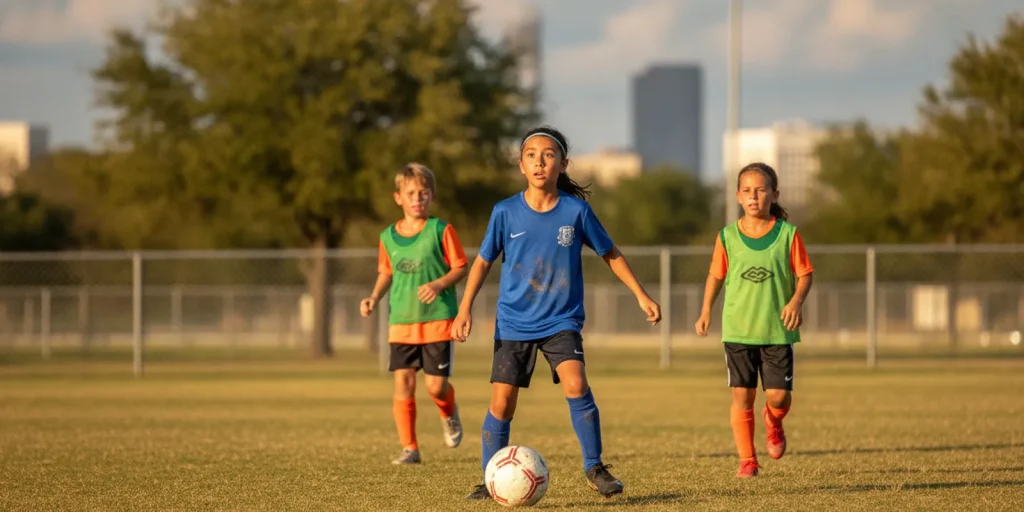
Game intelligence in soccer is a player’s ability to notice what is happening, understand the options, and choose a useful action as play changes. It is not a mysterious talent or simply knowing many tactics. Young players build it through experience: looking around, recognizing patterns, making decisions, and learning from what happens next.
Explore a free NEXO FC Open House
For parents, this matters because a player can have good technique and still need time to read pressure, spot a teammate, or decide when to move. Those abilities develop together. The goal is not to make every child play the same way. It is to help each player become more aware, composed, and effective in the situations they face.
What does game intelligence in soccer mean?
Game intelligence describes how a player connects perception, understanding, and action. A player sees the ball, teammates, opponents, open space, and the direction of play. They interpret that information, then act: pass, dribble, turn, shield, shoot, press, recover, or move to support someone else.
That process happens quickly, but it is not a single instant decision. Players continually update what they know. A passing lane that looked clear a moment ago may close. An opponent may step forward. A teammate may make a run. The player has to adjust.
It is helpful to distinguish game intelligence from memorizing instructions. A child may remember a coach’s preferred shape yet still need practice recognizing when to keep the ball, when to pass, and where to move after passing. Understanding the reason behind an action makes it easier to adapt when the game does not follow a script.
Which skills help a player read the game?
Scanning before the ball arrives
Scanning means briefly looking away from the ball to gather information. A player can check where pressure is coming from, notice a teammate in space, and see whether there is room to turn. The useful habit is not turning the head constantly. It is taking a quick look at the right moments, especially before receiving.
Parents can notice this without judging every touch. Does the player sometimes look around before the pass arrives? Do they seem to know where a teammate is? These observations are more useful than demanding that a child always make one particular choice.
Recognizing pressure and space
Reading pressure means noticing how close an opponent is and how quickly that opponent can challenge. Space is not only an empty patch of field; it is space a player can reach and use before an opponent closes it. A player may protect the ball when pressure is close, or move into an open lane when there is time.
For example, a player receives facing their own goal with an opponent nearby. Turning immediately may risk losing the ball. A safer first action might be a controlled touch away from pressure or a pass back to a teammate. If the player has time and sees space ahead, turning can help the team advance. The right choice depends on the picture in that moment.
Anticipating what may happen next
Anticipation is preparing for a likely next action without pretending to know the future. A defender might move closer because an opponent is about to receive. A teammate might run into space after a pass. A player near goal might get ready for a rebound. These are possibilities, not guarantees.
Young players learn to anticipate by seeing repeated patterns and trying responses. If a child guesses incorrectly, that does not automatically mean the decision was poor. The information available at the time matters. A useful review asks what the player noticed and what other options were possible.
Choosing and carrying out an action
Decision-making includes selecting an action and performing it. A player may see a teammate but lack the passing technique to reach them. Or they may have the technique but not notice the teammate soon enough. Game intelligence grows alongside ball control, passing, receiving, dribbling, and movement.
That is why technical repetition and realistic play complement each other. Practicing a pass can improve execution. Using the pass in a changing game helps a player learn when it may be useful.
Communicating and supporting teammates
Players also read the game through communication. A short call can alert a teammate to pressure or show that a passing option is available. Movement communicates too: creating an angle, making a run, or offering support can help a teammate keep possession.
Communication does not require a child to shout constantly. It can be simple and specific. As players become more comfortable, they can learn to share information in ways that help the whole group.
How can game intelligence develop over time?
Game reading develops through many connected experiences rather than one drill or one talk. A player needs time with the ball, chances to make choices, clear feedback, and permission to learn from mistakes. Coaches can guide attention toward a useful detail without deciding every action for the player.
- Notice:
The player learns to look for pressure, space, teammates, and the direction of play.
- Understand:
They begin to connect what they see with possible consequences, such as a pass being intercepted or a lane opening.
- Choose:
They select an action that fits the situation and their current abilities.
- Review:
They consider what happened and what they might notice next time.
This cycle repeats throughout a match. It is normal for a young player to perform it inconsistently, especially when tired, nervous, or facing a new level of challenge. Improvement can show up in small moments: turning away from pressure, supporting after a pass, or recognizing that a teammate needs help.
Age and experience matter, but children do not all develop at the same pace. Comparing siblings or teammates can hide the individual steps a player is taking. Focus on a specific habit the child can work on rather than a broad label such as “smart” or “not smart” on the field.
What can parents do to support better decisions?
Parents can help most by keeping soccer conversations curious and encouraging. A child who feels safe talking through a decision is more likely to reflect than one who expects a lecture after every game.
- Ask one open question.
Try “What did you see before you passed?” or “Where was the space?” Then give the child time to answer.
- Notice the process.
Recognize looking up, trying a new option, recovering after losing the ball, or helping a teammate—not only goals and assists.
- Let the coach coach.
Avoid calling instructions from the sideline that compete with the coach or overwhelm the player.
- Make room for mistakes.
A risky choice can become useful learning if the player understands the situation and tries again.
- Keep the conversation proportionate.
After a match, a simple “What was your favorite moment?” may be enough. The child does not need a full tactical review on the ride home.
If a player wants to talk about a difficult moment, help them describe the scene before evaluating it. What did they see? What were two possible choices? What might they try next time? This approach encourages reflection without making one play define the whole performance.
What simple activities can build game awareness?
Activities should match the child’s age, confidence, and experience. Keep them playful and safe, and follow the coach’s guidance. The aim is to invite observation and choices, not to turn family time into a test.
Look, then receive
With a partner and a ball in a suitable open area, have the child check over a shoulder before receiving a gentle pass. The partner can occasionally stand to one side and ask the child to identify where they are before the pass. Keep the pace comfortable. The practice is the glance and awareness, not speed.
Find a new passing angle
Pass the ball back and forth, with the receiver taking a few steps to create a new angle after each pass. Ask what changed when they moved. This simple pattern links passing with movement and helps children see that supporting a teammate continues after the ball leaves their feet.
Use a color or number cue
In a casual ball-control activity, a parent can hold up a familiar color or number while the child dribbles slowly. The child names it without losing control. Keep cues easy and stop if the player is distracted or frustrated. This is a light attention game, not a substitute for coached soccer practice.
Talk through a game moment
After watching a match or a short clip together, pause occasionally and ask what options the player sees. There may be more than one reasonable answer. Discuss what pressure, space, and teammate movement might change the decision. Do not use video review to criticize a child’s mistakes.
For broader development, families can learn about the age-appropriate focus of NEXO FC competitive youth soccer. Younger children may be more suited to movement, coordination, ball comfort, dribbling, simple game concepts, and small-sided play through NEXO Tots for ages 2–5.
How can families recognize useful progress?
Game intelligence is difficult to measure with one score. Instead, look for changes over time in how a player responds to familiar situations. A child might begin to check their surroundings before receiving, move to help after passing, or recover position when the team loses the ball.
Progress can also mean making a more considered choice, even when the result is not perfect. A pass can be intercepted despite being a sensible attempt. A dribble can fail while teaching the player when pressure is too close. The result matters, but it is not the only evidence of learning.
Ask the coach for a concrete example: “What is one decision-making habit my child is developing?” or “What is one situation they can keep practicing?” A specific answer is easier to use than a general judgment. If the answer is unclear, ask what the player should watch for in the next few weeks.
Families comparing a club environment can also read signs of good youth soccer coaching and consider how a program balances instruction, practice, and player decision-making. No single description guarantees that a setting fits every child; the player’s experience and the family’s needs matter.
What should families ask when evaluating a soccer program?
When exploring competitive development, ask how coaches help players understand the game, not only which formations they use. The answers should be clear enough for a parent to understand and grounded in what players do during sessions.
- How do players get opportunities to make decisions during training?
- How do coaches help children understand spacing, pressure, and support?
- How is feedback given after a mistake or a difficult decision?
- How does the training approach change for different ages and experience levels?
- What should a family know about schedule, location, commitment, and program details?
Families can visit a NEXO FC Open House to learn more when they are still evaluating fit. An introductory visit gives a family a chance to see a session and ask questions before deciding whether a program suits the player. Ask for current details directly rather than assuming dates, schedules, or costs.
Frequently asked questions about game intelligence
Is game intelligence the same as soccer IQ?
The phrases are often used to describe related ideas: recognizing what is happening, anticipating possibilities, and choosing an action. Neither phrase should be treated as a fixed measure of a child’s ability. Game understanding develops with practice and experience.
Can a young player develop game intelligence without playing competitively?
Yes. Players can practice awareness, movement, and decision-making in age-appropriate games and activities. Competitive soccer is not the only setting where children can learn to read play.
Does a mistake mean a player made a bad decision?
Not necessarily. A sensible choice can fail because of a difficult pass, an opponent’s movement, or an unpredictable bounce. To understand the decision, consider what the player could see at the time and whether the action matched that information.
Should parents tell a player what to do during a match?
It is usually more helpful to encourage than to direct every play. Conflicting sideline instructions can make it harder for a child to focus. Let the coach provide tactical guidance and discuss the player’s experience calmly afterward.
How quickly will game awareness improve?
There is no fixed timeline. Development varies with age, experience, practice opportunities, confidence, and the situations a player encounters. Look for gradual changes in habits rather than expecting a sudden transformation.
Ask about visiting a NEXO FC Open House
Game intelligence grows as young players learn to observe, decide, act, and reflect. With patient coaching and supportive adults, each match can offer another chance to understand the game and enjoy playing it.
Categories
NEXO FC
Find your player's next step
Four ways to play at NEXO FC, all led by the same coaching staff.