
How to Play Soccer for Beginners: First Steps for Kids
NEXO FC
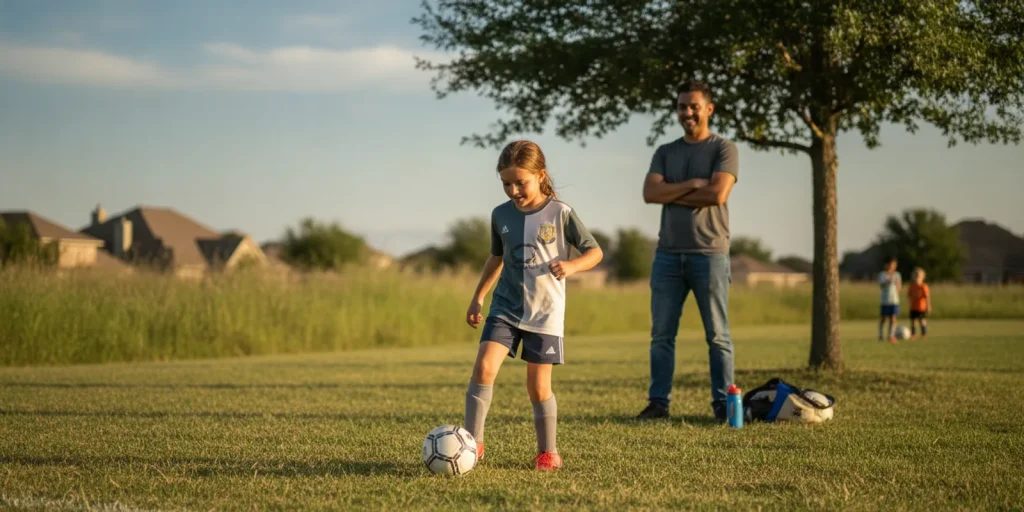
Learning how to play soccer for beginners starts with a ball, a little space, and permission to make mistakes. A child does not need to master every rule or skill before joining a game. Start with comfort on the ball, simple movement, and a few clear ideas about working with teammates. The goal of early practice is to help a player feel capable and curious.
What should a beginner learn first?
For a new player, the first goal is not a powerful shot or a complicated move. It is learning to notice the ball, move with it, and make a simple choice. Keep early practice short and playful. A few minutes of focused activity can be more useful than a long session that leaves a child tired or frustrated.
Begin with four building blocks:
- Ball comfort:
Let the child stop, roll, and gently tap the ball with either foot.
- Movement:
Practice walking, jogging, and changing direction while keeping the ball nearby.
- Looking up:
Encourage brief glances forward between touches, rather than staring at the ball the entire time.
- Sharing:
Introduce passing and receiving as a way to help a teammate, not as a test.
Children develop at different rates. A player who is hesitant to use one foot may become more comfortable through relaxed repetition. Praise effort and attention, not only goals or wins. If a child is enjoying the activity, that is a useful early sign that the practice is working for them.
How can a child get comfortable with the ball?
Choose a safe, open area and a ball that the child can manage. Give one instruction at a time. Demonstrate slowly, then let the player try without interrupting every touch. The aim is to build a relationship with the ball before adding speed or pressure.
Try simple first-touch activities
- Stop and start:
Roll the ball a short distance, follow it, and stop it gently under a foot. Repeat with the other foot.
- Tap and travel:
Take a few small taps forward, then stop. Encourage the child to keep the ball within a comfortable step.
- Turn around a marker:
Use a cone or safe household object. Guide the ball around it with small touches, then return.
- Pull and push:
Place the sole of one foot lightly on the ball, pull it back, and then push it forward with the same or opposite foot.
- Pass to a partner:
Stand close together and roll or pass the ball along the ground. Let the receiver settle it before sending it back.
Keep the distance short at first. If the ball keeps running away, reduce the pace and make the space smaller. You can add a challenge only after the basic action feels familiar: for example, ask the player to look up before passing or switch feet on the next round.
Try not to turn every interaction into a correction. A child may need time to coordinate balance, foot placement, and attention. One useful cue is enough: “small touches,” “stop it softly,” or “look toward your partner.” Then give them another chance. The next attempt teaches more than a long explanation.
How should a beginner use both feet?
Many children naturally choose one foot. That is normal, but gentle practice with both feet gives a player more options. The purpose is not to demand equal ability immediately. It is to make the less-used foot familiar enough that it does not feel unavailable during a game.
Start with low-pressure tasks. Roll the ball to the player’s left and right sides. Ask for one touch with the nearer foot, then allow the child to finish the action with the preferred foot. During dribbling, place two markers in a straight line and invite the player to use the left foot on one trip and the right foot on the next. Keep the route short so the exercise feels achievable.
Parents can also use a simple color or number game. Put one marker on each side of the child. Call “left” or “right,” and let the player move toward that marker with the matching foot. Do not make the response a race. The value is in hearing a cue, finding the ball, and making a controlled movement.
When passing, alternate the receiving foot rather than insisting that every pass be perfect. A beginner may trap the ball with the preferred foot, reset, and then pass with the other foot. This sequence builds coordination without making the child feel punished for an awkward touch.
How does a beginner pass and receive?
Passing and receiving connect a player to the rest of the team. At first, make each action predictable. Use a short distance, a slow ball, and a clear target. Add movement and choices only as the child grows more confident.
Passing with the inside of the foot
For a short ground pass, have the player face the partner and use the inside of the foot for a broad contact area. The supporting foot can point generally toward the target. Ask the child to use a gentle pace so the receiver has time to control the ball. Accuracy and a helpful pass matter more than force.
A useful practice pattern is pass, stop, and return. The parent or partner sends the ball slowly. The child receives it, takes a moment to settle it, and passes back. Once that feels comfortable, move one step farther apart. If the pass becomes difficult, return to the shorter distance instead of asking the player to kick harder.
Receiving a pass
Encourage the player to watch the ball approach and soften the contact so it stays nearby. Beginners can first stop a slowly rolled ball with a foot. Later, they can guide the ball into the space they want to move toward. A controlled first touch gives the player time to look up and choose what to do next.
Teach the idea of getting ready before the ball arrives. The player can turn their body toward the partner, keep their knees relaxed, and decide where the ball might go next. There is no need to demand a perfect stance. The important habit is to be alert rather than surprised by every pass.
Adding movement
After several stationary passes, have the player take two steps to a new spot before receiving. The passer can point or call the target. This teaches the beginner that soccer is not played from one fixed place. A player moves to help create a passing option, receives, and then finds the next action.
Keep the movement simple. One partner can walk sideways while the other passes into the path. If the ball travels too far, shorten the pass and slow the movement. The exercise should create a decision, not a scramble.
How can a beginner dribble with control?
Dribbling means moving while keeping the ball close enough to control. Ask the child to take small touches and change direction at an easy pace. A simple game is to dribble between two markers, stop the ball, and turn back. If the player is ready, invite them to lift their eyes between touches and notice where the open space is.
There are three useful ideas to introduce:
- Touch distance:
The ball should stay close enough that the player can reach it with the next step.
- Direction:
The player can move into an open lane rather than always traveling straight ahead.
- Awareness:
Briefly look up to notice a marker, teammate, or boundary before taking the next touch.
Try a quiet traffic-light game. “Green” means small touches forward, “yellow” means slow down, and “red” means stop the ball. Later, add “turn” and let the child choose which way to go. This develops control and listening at the same time.
Another option is a curved route around three markers. Make the turns wide at first. The player can use the inside of the foot to guide the ball around one side and the outside of the foot for a small adjustment. The goal is not to perform a trick. It is to keep the ball available while changing direction.
Skills do not have to be practiced in isolation forever. After a few passes, let the child move to a new spot to receive the next one. This connects technique to decision-making: where is the ball going, where can I move, and who is ready to help?
How should a beginner shoot?
Shooting can be exciting, but beginners should learn control before power. Begin with a large target and a short distance. A child can pass the ball into a small goal, between two cones, or toward a marked area on a safe wall when the setting allows it. Never aim toward people, windows, or vehicles.
For a basic ground shot, ask the player to approach at a comfortable pace, place the supporting foot near the ball, and contact the middle of the ball with the laces or another surface the coach has demonstrated. The player should follow through toward the target. Keep the explanation brief and let the child feel how different contacts change the ball.
Use a progression rather than a contest:
- Roll the ball and let the child stop it near a target.
- Place the ball still and ask for a gentle pass into the target.
- Take one dribbling touch before the shot.
- Receive a short pass, settle the ball, and then shoot.
- Add a moving target or a teammate only when the earlier steps are comfortable.
Celebrate a good decision even when the shot misses. A player who notices an open target, uses a controlled approach, or chooses to pass instead of forcing a shot is learning the game. Repeatedly asking for harder kicks can make a beginner focus on force instead of accuracy and awareness.
What are the basic rules a new player needs?
Rules vary by age group and competition format, so a beginner should follow the coach or referee’s instructions for the game being played. For a first introduction, focus on the shared purpose: players try to move the ball toward the other team’s goal, defend their own goal, and work within the boundaries of the field.
- Use feet and other permitted body parts to play the ball; players generally may not deliberately handle it with their hands or arms.
- Keep the ball in play by staying within the marked boundaries. When it goes out, the restart depends on how and where it left the field.
- Play fairly. Do not trip, push, or use unsafe contact to get the ball.
- Listen for the whistle and follow the referee’s restart direction.
- Goalkeepers have special rules in their own penalty area; a coach can explain the version used in the child’s game.
- Respect teammates, opponents, coaches, referees, and the playing space.
Do not expect a child to memorize every restart before playing. Small-sided games and guided practice help rules make sense in context. Parents can review the parent and player guide to soccer rules for a fuller overview, then ask the coach which age-group modifications apply.
What does a beginner do during a game?
A new player may wonder where to stand when the ball is far away. Give them a few simple questions instead of a long list of positions. Where is the ball? Where is the open space? Can I help the teammate who has it? Can I move between the ball and my own goal when defending?
When the team has the ball, the beginner can spread out, move into open space, and show a teammate where a pass might go. The player does not need to stand perfectly still or run constantly. A few purposeful steps can create a better option. If the ball comes close, the player can try to control it, pass, or dribble away from pressure.
When the other team has the ball, the beginner can recover toward their own goal, stay between the ball and a useful target, and avoid diving into a challenge. A coach will teach the group’s defensive approach. At first, the key ideas are effort, awareness, and safe movement.
After losing the ball, teach a calm response. The player can try to recover, help a teammate, or move into a useful position. A mistake is not a reason to stop playing. The next moment is another chance to make a decision.
How can parents organize a short practice?
A home session does not need to resemble a professional training session. A clear 20- to 30-minute routine can give a child useful repetition without taking over the day. Adjust the length for the child’s age, energy, weather, and attention.
A sample 25-minute beginner session
- Arrival and movement, 3 minutes:
Walk, jog, change direction, and gently roll the ball with a foot.
- Ball comfort, 5 minutes:
Practice stop-and-start, taps, sole pulls, and turns around a marker.
- Passing, 5 minutes:
Complete short passes with a partner, alternating the receiving foot when comfortable.
- Dribbling, 5 minutes:
Move through a wide route, stop at a signal, and look up before the next touch.
- Choice game, 5 minutes:
Let the child decide whether to dribble to a target, pass, or shoot into a safe goal.
- Review, 2 minutes:
Ask what felt fun and what the player would like to try next time.
Use one main theme per session. For example, Tuesday can focus on stopping and turning, Thursday on passing, and Saturday on dribbling into space. The schedule does not need to be rigid. If the child is engaged by passing, continue that activity. If attention fades, finish with an easy game and stop on a positive moment.
Parents should check the surface before practice and make sure footwear is suitable for the setting. Provide water and breaks, especially in warm weather. A child who is uncomfortable, unwell, or unusually tired should pause rather than push through.
How can practice become more challenging without becoming stressful?
Progress by changing one feature at a time. Increase distance only after control is reliable. Add a moving partner only after the child can pass to a stationary target. Add a defender only after the player understands where to look and has an option to pass.
A helpful challenge ladder looks like this:
- Level one:
The ball is still, the target is large, and the player has plenty of time.
- Level two:
The ball moves slowly and the player takes one or two touches.
- Level three:
The player chooses between two targets or routes.
- Level four:
A partner moves, creating a changing passing option.
- Level five:
A small game adds teammates, opponents, boundaries, and a goal.
If success drops sharply, step back one level. That is not going backward. It gives the player a chance to repeat the skill with better timing and confidence. The best challenge is difficult enough to require attention but manageable enough to invite another attempt.
Change the questions as the child develops. Early on, ask “Can you stop the ball?” Later, ask “Where could your first touch go?” Eventually, ask “What did you see before you passed?” These questions encourage decision-making, spatial awareness, and tactical clarity without turning practice into an exam.
How can parents make practice useful and enjoyable?
Parents can help by making practice feel safe, encouraging, and manageable. Set a simple goal for each session, such as five gentle passes or a few turns around a marker. End while the child still has energy to enjoy another try later.
- Offer choices:
Ask whether the child wants to pass, dribble, or take a short break.
- Notice decisions:
Praise looking up, trying the other foot, or finding a teammate.
- Keep feedback specific:
One clear suggestion is easier to use than a long list.
- Allow mistakes:
Losing control of the ball is part of learning where the next touch should go.
- Make room for play:
Finish with a simple challenge or a relaxed game rather than constant drills.
- Let the child lead sometimes:
A player who invents a target game is practicing creativity and ownership.
At home, a small safe space is enough for gentle touches and short passes. Check the playing surface for hazards and avoid aiming shots toward people, windows, or parked vehicles. For ideas on choosing and preparing equipment, see the soccer equipment checklist for families.
Try to separate coaching time from encouragement time. During an activity, give one cue and allow a few attempts. Afterward, mention something the child did well and ask what they noticed. Constant commentary can make a player worry about each touch. Quiet observation can give them room to solve problems.
When is a beginner ready to play with others?
A child can try a group activity before feeling confident in every skill. Readiness is less about being “good enough” and more about whether the player is curious, willing to participate, and able to follow simple directions with support. It is normal for a new player to spend time watching, ask for help, or need a break.
Before choosing a program, consider:
- Does the activity match the child’s age and current comfort level?
- Can the family observe a session or ask how coaches introduce beginners?
- Does the environment encourage effort and respect, including when a player makes mistakes?
- Are schedule, location, program expectations, and registration details clear?
- Will the child have opportunities to touch the ball and make decisions, rather than only wait in line?
- Does the program explain what happens if a player needs encouragement, water, or a short break?
NEXO FC is a competitive youth soccer club for ages 6–12, while NEXO Tots offers early-childhood soccer for ages 2–5. Families can learn about the NEXO FC program and use an Open House to see whether a structured soccer setting feels like a fit. An Open House lets a family explore without treating that visit as a commitment to a longer program.
What should families observe at an introductory session?
Watching a session can help a parent understand more than a program description alone. Notice how often children are moving, how coaches explain activities, and whether beginners have a way to participate successfully. A well-organized session can include challenge, but it should also give players clear instructions and opportunities to try again.
Look for activities that connect skills to the game. A line of isolated kicks may have a place, but beginners also benefit from receiving, turning, finding space, and making choices. Ask whether the activity is appropriate for the child’s age and experience. A young player may need more movement and imagination, while an older beginner may be ready for more structured passing and small-sided play.
Pay attention to the tone around mistakes. Coaches can correct technique while preserving a player’s dignity. Encouragement does not mean avoiding standards. It means explaining the next action clearly and helping the player rejoin the activity. Families should feel comfortable asking how the program balances serious development with a positive, family-centered culture.
What changes as a child gains confidence?
Once a player is comfortable moving the ball, gradually add decisions. Instead of always telling the child where to pass, ask what they see. Put two targets ahead of them and let them choose. Invite a partner to move into open space. These small choices build awareness along with technique.
A useful progression might look like this:
- Explore:
Stop, start, and move the ball in a clear space.
- Connect:
Pass to a nearby partner and receive a return pass.
- Choose:
Decide whether to dribble toward space or pass to a teammate.
- Support:
Move after passing so the player can receive again or help the teammate.
- Defend:
Recover toward the goal and learn to slow an opponent safely.
- Play:
Try a small game with simple boundaries and a few players.
- Reflect:
Ask what felt easy, what was challenging, and what the player wants to try next time.
Progress does not always appear as more speed or more goals. A child may be improving by scanning before receiving, keeping a first touch close, recovering after losing the ball, or communicating with a teammate. These habits support confident growth and help technique become useful in a game.
Resilience is another part of development. A beginner will misplace passes, lose races to the ball, and sometimes feel unsure. Help the player name the next controllable action: recover, find space, ask for the ball, or try the skill again. This approach builds a steadier response than treating every mistake as a crisis.
What should families ask a coach?
Good questions help parents understand how a program supports beginners and what participation involves. Ask directly and listen for clear, age-appropriate explanations.
- How do you introduce a new player to the group?
- What skills and game ideas are appropriate for this age?
- How do coaches give feedback when a player is learning?
- How much time do players spend active with the ball?
- How do activities develop decision-making and spatial awareness?
- What are the schedule, location, and registration steps?
- Can our child observe or attend an introductory event before we decide?
- What should a player bring, and what happens if they need a break?
For a wider perspective on coaching and practice structure, read NEXO’s article on what good youth soccer training looks like. Families comparing organized options may also find the youth soccer club guide useful. Use those resources to prepare questions, not to assume every club follows the same format.
How can a beginner keep learning between sessions?
Consistency matters more than elaborate equipment or complicated routines. A few relaxed touches on different days can help a child remember how the ball responds. Keep practice flexible: if the player is tired or distracted, switch to a simple passing game or stop for the day.
Use ordinary moments to build awareness. On the way to practice, ask the player what they might do if a teammate is open. After a game, ask which movement felt comfortable. When watching soccer, pause occasionally and ask where a player could move next. These conversations can make decision-making visible without turning family time into a lesson.
A small weekly plan might include one ball-comfort session, one passing session, and one free-play session. Free play matters because it lets the child experiment with turns, changes of direction, and creative solutions. Organized instruction can add guidance and teamwork; informal play gives the player ownership.
What beginner mistakes can families avoid?
Early learning is easier when the child understands what to try next. Some common habits can make practice feel harder than it needs to be, even when the intention is helpful. The first is giving too many instructions at once. A player who is trying to watch the ball, remember foot placement, find a target, and move quickly may stop noticing any of those things. Choose one focus, such as a soft first touch, and return to the other ideas later.
A second mistake is measuring progress only by goals. Goals are exciting, but they do not show every useful action. A player who creates space, makes a safe pass, tracks back, or encourages a teammate is contributing to the game. Parents can ask about those moments after practice. This gives the child a broader understanding of what good soccer looks like.
A third mistake is making every practice competitive. A race can be fun, but a beginner may begin to rush touches or avoid the less-used foot because losing feels uncomfortable. Alternate challenges with cooperative activities. See how many passes a pair can complete, or let the child design a route for the parent to follow. Cooperation keeps attention on control and problem-solving.
A fourth mistake is using a space that is too large. When the ball rolls far away after every touch, the child spends more time chasing than learning. Begin in a compact, safe area and widen it as control improves. The right space makes success possible while still requiring the player to pay attention.
Finally, avoid comparing a beginner with an older sibling, teammate, or player seen online. Children bring different experiences, coordination, confidence, and interests to the field. Compare the player with their own earlier attempts. If the first touch is closer, the player looked up once more, or they recovered from a mistake, there is meaningful progress to recognize.
How can a child learn to communicate on the field?
Soccer is easier when players share information. A beginner does not need a large vocabulary or a loud voice. Start with a few useful signals and model them during simple passing activities. The player can call a teammate’s name, ask for the ball, say “turn” when there is space, or say “help” when pressure is nearby.
Practice communication without making it embarrassing. During a partner passing game, require the receiver to say the passer’s name before the ball arrives. In a three-person activity, ask the player without the ball to point toward an open space. The purpose is to connect movement, observation, and language. If a child is shy, pointing and eye contact are reasonable first steps.
Parents can reinforce useful communication by responding to it. If the player calls for a pass, send the ball at a manageable pace. If the player points to a target, acknowledge the idea before correcting anything. This shows that communication has a purpose. Over time, the child can learn that teammates do not need to wait silently for the ball; they can help one another make decisions.
Communication also includes listening. A player may need to hear a teammate, coach, whistle, or boundary instruction while moving. Short games with a stop signal can build this habit. The player dribbles, listens for a word or clap, and then stops, turns, or passes. Keep the signals consistent so the child can focus on the action rather than guessing what each sound means.
How should a family choose the next step?
Start with the child’s age, interest, and current experience. A preschool player may benefit from age-appropriate movement, coordination, ball comfort, dribbling, simple game concepts, and small-sided play. An older beginner may want more practice with passing, receiving, positioning, and decisions under light pressure.
Then compare the practical details. Consider travel time, session schedule, venue, registration process, and what the family needs to bring. Ask staff about details that are not clear rather than guessing. Program availability, dates, and requirements can change, so confirm the current information before registering.
Families in Greater Houston can explore options based on the child’s age and interest. NEXO’s published programs include NEXO Tots for ages 2–5 and NEXO FC for ages 6–12. NEXO also offers seasonal camps, tryouts, and Open Houses. Families can review NEXO Soccer Camps when a school-break activity is the more appropriate next step. Program details and availability can change, so review the relevant page and ask staff when a specific schedule or requirement is unclear.
Explore the free NEXO FC Open House
Every player starts somewhere. Keep the first steps simple, make room for curiosity, and let confidence grow through enjoyable practice and supportive play.
Categories
NEXO FC
Find your player's next step
Four ways to play at NEXO FC, all led by the same coaching staff.