
Soccer Ball Size by Age: Parent Guide for Kids
NEXO FC
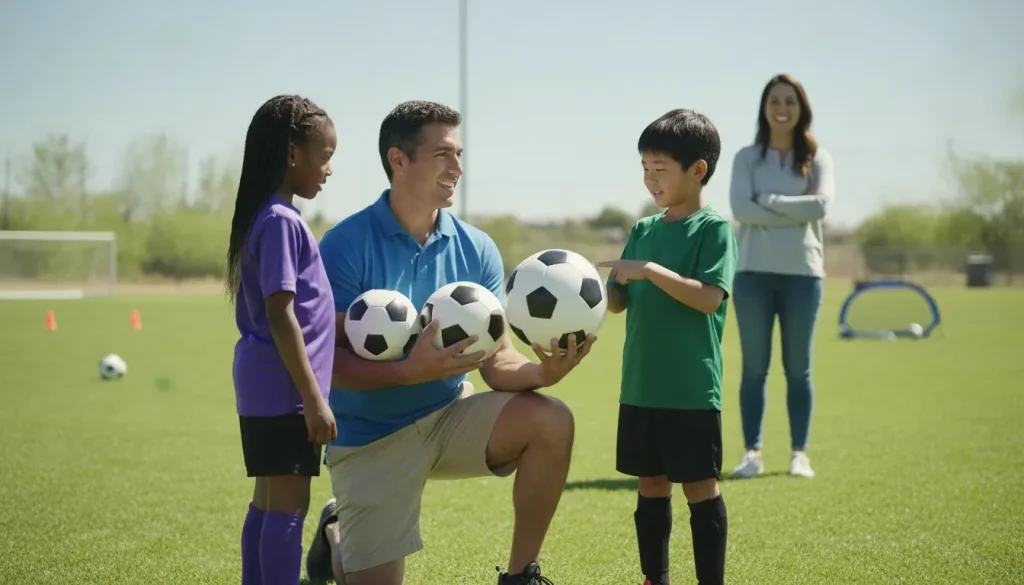
Buying a soccer ball for your child should be simple, but the size labels can make parents pause. The usual soccer ball size by age guide is size 3 for younger players. Size 4 for most players ages 8 to 12, and size 5 for players around age 13 and older. The important exception is the early-childhood stage: children ages 2 to 4 may be more comfortable with a soft or lightweight ball chosen with a coach. While many 5-year-olds are ready for size 3. Use the chart below as a starting point, then follow your child’s league or coach if its equipment rules are different.
Explore the NEXO FC Open House and registration options to find an age-appropriate next step for your player.
Quick soccer ball size by age chart
This chart gives families a practical starting point for home practice and most youth soccer settings. Age bands overlap at transition points, so the team or league rule should always take priority for match day.
|
Child’s age |
Common ball size |
Parent’s buying note |
|
2 to 4 |
Ask the coach; soft or lightweight options are often easiest |
Prioritize comfort, grip, and simple ball play over a competition label. |
|
5 to 7 |
Size 3 |
A junior ball is easier for young players to stop, dribble, and strike. |
|
8 to 12 |
Size 4 |
This youth size usually bridges smaller-ball technique and the full-size game. |
|
13 and older |
Size 5 |
The full-size ball is the common choice, unless a league specifies otherwise. |
The U.S. Youth Soccer Player Development Initiatives provide a useful age-group reference: size 3 is commonly paired with U6 to U8, size 4 with U9 to U12, and size 5 with U13 and older. Different leagues can set their own rules, and a coach’s current instruction is the best source for a specific team.
What size soccer ball does a 3-year-old need?
There is not one universal competition ball requirement for every 3-year-old. At this age, the goal is comfortable movement, playful touches, and a positive introduction to the ball. A standard size 5 can feel too large and heavy for many young children. Some families choose a soft, lightweight ball or a smaller novelty ball for casual play. But the best choice depends on the child’s coordination, confidence, and the program’s instructions.
Look for a ball your child can move with both feet without constantly losing control. If the ball is used indoors or in a small space, soft construction can also make early play more comfortable for the whole family. Ask the coach what players should bring before buying a match-style ball.
What size soccer ball is right for ages 5 to 7?
For most children ages 5 to 7, size 3 is the practical choice. It is smaller than a full-size ball. That can make it easier to learn the basic actions at this stage: stopping. Taking a first touch, dribbling around an obstacle, passing to a parent, and striking with balance.
A smaller ball is not a shortcut. It gives a young player more chances to make contact and adjust their body position. Those repetitions can help a child build confidence without turning every touch into a struggle with the equipment. If a coach or league uses a different size for a particular age group, use that direction for organized sessions and games.
What size soccer ball should an 8-year-old use?
An 8-year-old is often at the transition from size 3 to size 4. Many programs place players entering the U9 age group on size 4, while a child still playing in a younger age group may continue with size 3. Check the team’s age group rather than using the birthday alone.
For home practice, either size may be reasonable during the transition if your child can control it comfortably. If the ball is for team training, buy the size the coach names so the player practices with equipment that feels familiar at sessions and games. This is usually more useful than buying the larger size early just because your child will eventually use it.
What size soccer ball do children ages 9 to 12 use?
Size 4 is the common youth soccer ball for ages 9 to 12. It gives players more surface area and weight than size 3 while remaining easier to manage than a full-size ball. This makes it a useful fit for receiving, passing, dribbling, shooting, and small-sided game work during the middle childhood years.
At this stage, the quality of practice matters more than buying the most expensive ball. A properly sized ball that is inflated according to its label and used regularly is usually a better choice than a premium ball that stays in a closet. If your child plays in a league with a published equipment rule, follow the league’s rule for matches and ask whether the same size is expected at training.
When should a player move to a size 5 soccer ball?
Size 5 is the full-size soccer ball and is commonly used from U13 onward, including older youth, high school, college, and adult play. Many players move to it around age 13, but the exact transition depends on the competition format and the organization running the program.
There is no advantage to rushing a younger player into size 5 for everyday technical work. If the ball is oversized for the player. First touches can become less consistent and the child may focus on simply moving the ball rather than learning to control it. A size 5 ball can still be used occasionally for curiosity or family play, but it should not replace the size prescribed for the player’s team.
Why the right ball size matters for development
Ball size changes the feel of every basic action. A ball that matches a player’s age group gives the child a realistic chance to control the ball with the technique they are learning. That matters because youth development is built from repeated actions, not from one impressive kick.
- First touch:
The player can receive the ball without being overwhelmed by its size or weight.
- Dribbling:
A manageable ball makes it easier to take small touches and change direction.
- Passing:
The player can practice the correct contact point and pace instead of swinging harder to move an oversized ball.
- Finishing:
A suitable ball lets the player work on balance and placement, not just power.
- Confidence:
More successful touches make practice feel like a challenge the child can solve.
That does not mean the ball must be perfect for every activity. Coaches may use different equipment for a particular drill, and a player can benefit from learning to adapt. The basic home ball should simply be a sensible match for the player’s current age group and program.
See NEXO Tots for age-appropriate early ball play if you are choosing equipment for a child ages 2 to 5.
How to choose a soccer ball beyond the size number?
Once you know the likely size, use these checks before you buy:
Check the ball’s label and construction
Look for the size, intended use, and care information on the product label. Training balls are built for frequent practice, while match balls can be selected to meet a league’s requirements. You do not need the most expensive option for a child who is learning basic technique at home.
Choose a surface that fits the playing environment
Think about where your child will use the ball. A family practicing on grass may want a different surface feel from a player working on a hard court or indoor floor. Follow the program’s guidance for indoor and outdoor use, and avoid treating one ball as ideal for every surface.
Inspect the shape, seams, and valve
A ball should hold its shape and roll predictably. Before buying, check for visible damage, uneven panels, or a valve that looks loose. After practice, store the ball away from sharp objects and extreme heat. Good care helps a correctly sized ball stay useful for longer.
Inflate it according to the manufacturer’s range
Too little air can make the ball difficult to pass and control. Too much air can make it feel hard and uncomfortable. Use the inflation range printed by the manufacturer rather than guessing by feel, and check the ball periodically because air naturally escapes over time.
Should the same ball size be used at home and at practice?
Using the same size at home and at practice is usually the simplest option. Familiar equipment lets a child focus on the skill instead of adapting to a different ball every time. It is especially helpful when a player is preparing for a team session, camp, or evaluation.
There are still good reasons to use another ball for a short activity. A coach may select a lighter ball for a movement game, or a family may use a soft ball indoors. Those are additions to the player’s normal practice equipment, not reasons to ignore the team standard. When in doubt, ask the coach before purchasing a full set of balls.
How NEXO families can connect ball choice to a program
Ball size is only one part of finding a good soccer experience. The right program should also match the player’s age, current comfort, family schedule, and development goals.
NEXO Tots is presented for ages 2 to 5 and focuses on age-appropriate movement, coordination, ball comfort, dribbling, simple game concepts, and small-sided play. Families choosing a ball for that stage should ask what equipment the current session expects rather than assuming every child needs the same size.
NEXO FC is advertised for ages 6 to 12 and emphasizes decision-making, spatial awareness, tactical clarity, technique, teamwork, and confident player growth. Families considering a more structured development setting can review the program information and follow the current team or tryout instructions for equipment.
NEXO Soccer Camps include all-skill youth training, but age ranges and schedules can vary by camp. Check the current camp page for the specific session and ask what players should bring. If you are still comparing options, the NEXO Open House is a lower-pressure way to learn about the club and see whether the approach fits your family.
Request current NEXO program details or review Open House registration before you buy equipment for a new team or program.
Frequently Asked Questions
What size soccer ball is best for a 5-year-old?
Size 3 is the common starting point for a 5-year-old in many youth soccer settings. Confirm the program’s rule, especially if the child is joining an organized team or camp for the first time.
What size soccer ball should a 7-year-old use?
Most 7-year-olds use size 3. It is a practical junior size for learning first touch, dribbling, passing, and shooting. The child’s current age group, not only the calendar age, should guide the final decision.
What size soccer ball does a 9-year-old need?
Most 9-year-olds use size 4. It is the common youth size for the U9 to U12 range, but the coach or league can confirm the exact standard for that season.
Does a 12-year-old use a size 4 or size 5 ball?
A 12-year-old commonly uses size 4, especially when playing in an age group that remains within the U9 to U12 youth range. Some organizations transition players based on competition format, so ask the coach before buying a size 5.
Can a younger child use a size 5 soccer ball?
A younger child can kick a size 5 ball for casual fun, but it is usually not the best main practice ball if it makes control difficult. Use the size prescribed by the program and choose comfort and quality touches over rushing to a full-size ball.
Is ball size more important than brand?
For most developing players, a correct size and dependable construction matter more than a famous brand. Start with the team’s size requirement, then choose a ball that holds its shape, suits the playing surface, and fits your practice budget.
Parent checklist before buying
- Confirm the player’s current team or league age group.
- Ask the coach which size should be used at training and games.
- Choose a comfortable, durable ball that fits the playing surface.
- Check the recommended inflation range and inspect the ball before each session.
- Prioritize regular touches and enjoyment over an expensive label.
The best soccer ball is the one your child can control, use often, and bring confidently to the next session. Start with the age-based chart, confirm the team standard, and let your child’s comfort and development guide the final choice.
Categories
NEXO FC
Find your player's next step
Four ways to play at NEXO FC, all led by the same coaching staff.