
What Should Soccer Practice Include for Young Players?
NEXO FC
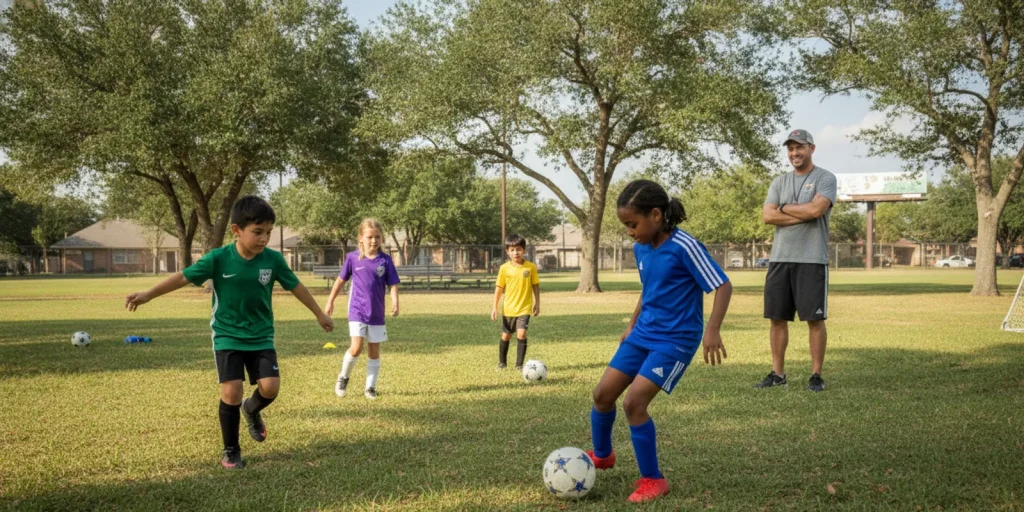
What should soccer practice include for young players? A useful soccer practice gives children repeated chances to handle the ball, notice what is happening around them, make choices, and try those choices in game-like situations. The exact activities should fit the players and the program, but practice should connect skills to decisions rather than leave learning inside a line of isolated drills.
Parents do not need to judge a session by how complicated it looks or how tired a player is afterward. A more helpful question is whether the player had meaningful involvement, understood what the activity was teaching, and had chances to use the skill under changing conditions. This guide breaks down what that can look like, what varies by age and experience, and what you can observe when you visit a program.
What is the purpose of a good soccer practice?
Practice is a place for players to learn and repeat actions that help them play the game. A child may need to become more comfortable receiving the ball, improve a pass, protect possession, recognize open space, or work with teammates to solve a problem. These aims connect: a player can use a technical skill more effectively when they can recognize when and where to use it.
That is why a session made up only of unopposed repetition may be incomplete. Repetition can help a player become familiar with a movement, but soccer changes from moment to moment. Teammates move, opponents close space, and the ball may arrive at an unexpected speed or angle. Practice can gradually introduce those changing conditions so players learn to adapt rather than simply repeat a memorized pattern.
A useful session also gives the coach information. When a player struggles to receive a pass, the next step may be a simpler ball, more space, a reminder to look before receiving, or another chance to try. If players solve an activity easily, the coach may add a decision, a defender, or a tighter area. The activity should respond to what the players are showing, not just continue because it was on a plan.
For families comparing programs, it can help to read about youth soccer training alongside this practice guide. NEXO describes its development priorities as decision-making, spatial awareness, tactical clarity, technique, resilience, and teamwork. Those are useful ideas to look for in the way a session connects individual actions with team play.
What should players experience during practice?
There is no single session formula that every team must follow. A coach may change the order or time spent on an activity to suit the group, field, weather, and learning goal. Still, parents can look for a few broad ingredients: players moving with the ball, purposeful practice of a skill, activities that ask them to make choices, opportunities to work with teammates, and a chance to apply learning in a game or game-like challenge.
1. Frequent contact with the ball
Young players generally benefit when they get many chances to touch, carry, receive, and pass the ball rather than spend long stretches waiting for a turn. In a well-organized activity, players are not necessarily all doing the same thing at once, but the design gives each child a reason to stay engaged. A coach can use pairs, small groups, multiple balls, or more than one activity area to reduce idle time.
Ball contact by itself is not the whole goal. A player can touch the ball many times in an activity and still have little chance to look up or choose what to do. Notice whether the child can try different actions and whether the activity gives them a purpose, such as moving into open space, finding a teammate, or keeping the ball away from a defender.
2. Technical actions with a reason
Dribbling, passing, receiving, turning, and shielding are building blocks. At first, a coach may ask players to focus on a particular movement without much pressure. The instruction should be simple enough for the child to try: keep the ball close while changing direction, cushion the ball into a useful space, or pass to a teammate’s feet. Players need room to make mistakes and try again.
Next, the practice can give the action a context. Instead of passing only to a stationary target, players might move after passing, choose between two teammates, or receive while another player approaches. The point is not to make every drill difficult. It is to help players connect technique with the kind of information they encounter in a match.
Parents can listen for clear, specific feedback rather than a constant stream of corrections. “Can you turn away from the defender?” gives a player a problem to solve. A short cue about balance, the surface of the foot, or the direction of the first touch may be useful when it fits the moment. Too many instructions at once can make it harder for a child to notice and learn.
3. Opportunities to scan and make decisions
Soccer players need to gather information before and during an action. Looking around can help a player see where pressure is coming from, where a teammate is moving, and which direction may be open. A practice can encourage this awareness by asking players to choose what to do rather than announcing the answer before every repetition.
For example, a receiving activity could offer more than one passing option. A player has to check the space, receive with control, and decide whether to pass, turn, or carry the ball. In a small game, a coach might pause briefly to ask what the player noticed, then restart so the player can test a different choice. Reflection should help the player see the situation, not become a long lecture.
Decision-making develops through opportunities to try, see what happens, and adjust. A player who chooses a pass that is intercepted is not automatically failing. The coach can help the player consider whether the teammate was available, whether a different touch would have opened the passing lane, or whether carrying the ball was an option. A supportive practice treats mistakes as information while still helping players learn responsibility for their choices.
4. Teammates and game-like pressure
Soccer is a team game, so practice should give players chances to communicate and cooperate. They may learn to offer a passing option, move after releasing the ball, support a teammate who is under pressure, or work together to win possession back. These actions can be introduced in pairs or small groups before players try them in larger activities.
Opposition adds a decision to the activity. That does not mean every exercise needs intense pressure. A defender can begin at a distance, a player can have extra space, or the teams can be uneven so the attacking group has an advantage. The coach can adjust the challenge so players have time to make choices without making the outcome certain.
Small-sided games are one way to bring these pieces together. With fewer players in a smaller area, children often have more chances to become involved and must respond to changing positions. A simple game can ask players to keep possession, find a target, or move the ball into a particular area. The coach can then observe whether players are finding space and supporting one another, not only who scores.
5. A chance to use the learning in play
A session can include a game or challenge that lets players apply the idea they have been practicing. If the focus was finding space after a pass, the final activity can reward movement that creates another option. If players practiced receiving away from pressure, the coach can notice whether they try that action when a defender approaches.
The activity does not have to look exactly like a full match to be valuable. A smaller game may make the target skill easier to see and give players more repetitions. A coach can change the number of players, the shape of the playing area, or the task to bring out a particular decision. What matters is that the players understand the problem they are working on and get a fair chance to solve it.
How should practice change as players grow?
Children do not all learn at the same pace, even when they are the same age. Previous playing experience, confidence, coordination, attention, and comfort in a group can all influence what feels manageable. Age-aware coaching begins with the player in front of the coach and adjusts the activity so it is challenging without being needlessly confusing or intimidating.
For a younger or newer player, an activity may use fewer instructions, more space, shorter turns, and playful ways to explore the ball. Success might mean trying to stop the ball, changing direction, or joining a simple game with a teammate. A child who is just becoming comfortable with soccer may need time to understand the routine before being asked to perform a complex combination.
As players gain experience, activities can add more options and pressure. They might be asked to recognize a passing lane, make a choice before a defender arrives, or coordinate with teammates to keep possession. This is not a rigid ladder: an experienced player may need a simpler task to learn a new skill, while a beginner may be ready for a more open-ended game in which they discover solutions themselves.
Families with very young children should look for activities that fit early development rather than expect a miniature version of adult training. NEXO Tots serves ages 2–5 and focuses on age-appropriate movement, coordination, ball comfort, dribbling, simple game concepts, and small-sided play. Parents can review the NEXO Tots program information to understand that offering; do not assume every child at this age will be ready for the same activity or pace.
For older children, a practice can include more tactical questions and more responsibility for reading what happens next. Coaches can still keep explanations short and provide time to play. The goal is not to make young players memorize a complicated system. It is to help them recognize useful cues and make choices they can explain and repeat.
How can parents tell whether players are learning?
Parents usually see only a portion of a child’s development from the sideline. A single practice can look messy when players are experimenting, and a polished drill does not prove that a skill will transfer into a game. Look for patterns across time and consider whether players are being given chances to make decisions, receive feedback, and try again.
- Players stay involved. There are opportunities to move, touch the ball, and take a turn, with limited waiting that has no clear purpose.
- The activity has a clear aim. Players can understand what they are trying to do, even if they do not execute it perfectly.
- Coaching cues are understandable. Instructions and feedback are specific enough for a young player to use.
- Players get room to decide. The coach does not dictate every pass or movement before the situation develops.
- The challenge can change. The coach adapts space, numbers, or rules when an activity is too easy or too difficult.
- Teamwork is visible. Players are encouraged to support each other, communicate, and share responsibility.
- Effort and mistakes are handled constructively. Players can attempt something difficult without being demeaned when it does not work.
Progress may be subtle. A child who once kicked the ball away under pressure might begin to protect it, look for a teammate, or attempt a turn. Another player may become more willing to ask for the ball or recover after losing possession. These are examples of behaviors a family can notice; they are not promised outcomes, and improvement is rarely a straight line.
Ask your child what they practiced and what choice they made during an activity. Questions such as “What did you notice before you passed?” or “What could you try next time?” invite reflection without turning the ride home into another coaching session. If the child is tired or does not want to talk, respect that. A calm, supportive response can make it easier for the player to stay curious and enjoy learning.
What are useful ways to practice at home?
Home practice can be short and simple. It does not require a full field, elaborate equipment, or a parent who has played soccer. If the space is safe and there is room to move, a ball and a few objects as markers can be enough for basic activities. Follow any program guidance about safe practice, and avoid using a space where a stray ball could reach a road, glass, or other hazard.
Try a small activity with a clear purpose, then let the child repeat it in a way that stays enjoyable. For example, a player can dribble around a few spaced objects, change direction when a parent calls a simple cue, or pass back and forth while moving to a new spot. If the child has a sibling or friend to play with, a one-versus-one game in a safe area can add a choice and an opponent. Keep the challenge appropriate and stop before frustration takes over.
Parents can help by asking what the player wants to work on, setting up the space, and offering encouragement. You do not have to correct every touch or explain tactics. If you are unsure about a technique, ask the child’s coach for one simple cue that matches what the team is learning. That keeps home activity supportive rather than creating conflicting instructions.
It is also fine for a child to choose free play. Playing for fun can help children explore the ball and invent their own challenges. A practice plan should not crowd out rest, school, family time, or unstructured play. The right amount of additional activity depends on the child, schedule, and coach’s guidance; a longer session is not automatically a better one.
How can families compare soccer programs?
A program’s description is a starting point, not a full picture of what a particular practice will feel like. If you are comparing options, ask how coaches help players learn, how activities are adjusted for different experience levels, and what a parent can observe before deciding. The answers should be clear and fit the child’s needs, schedule, and comfort.
- Ask what players do. How does practice balance individual ball work, decisions, teamwork, and play?
- Ask how instruction changes. What happens when a player is new to the activity or ready for more challenge?
- Ask how coaches respond to mistakes. How do they encourage effort and help a player understand the next attempt?
- Ask about the schedule and location. What commitment should your family expect, and where are sessions held?
- Ask what is included and what it costs. Request current details directly rather than assuming fees, equipment, travel, or season terms.
- Ask about the next step. Can your child attend an introductory event, observe, or try an activity before your family makes a decision?
When a live observation is available, watch the whole group rather than focusing only on the strongest or most confident player. Do beginners get a chance to participate? Are instructions clear? Do players spend the session waiting, or are activities organized so they can stay active? How does the coach handle a player who is uncertain or makes an error? These observations will not answer every question, but they can help you start a useful conversation.
Ask your child what they noticed, too. Did they feel welcome? Could they follow the activity? Was there something they wanted to try again? A young player’s view is one part of the decision alongside parent priorities such as location, timing, program expectations, and cost. There is no need to decide based on one moment or compare a child’s development with someone else’s.
NEXO FC describes its program as competitive youth development for ages 6–12, with a focus on decision-making, spatial awareness, tactical clarity, technique, resilience, and teamwork. Families can review the NEXO FC program overview and use an Open House or registration information to explore the club in a low-pressure way. Confirm current details with the club before relying on dates, availability, or terms.
Families evaluating different entry points can also read about NEXO programs. For school-break options, the NEXO Soccer Camps page provides program information; confirm current dates, details, and eligibility directly, as the page has published varying age ranges. Families considering tryouts can check the current tryout information and ask about the process before making plans.
What might a practice sequence look like?
There is no required order for every team, but thinking through a sample sequence can help parents understand how practice activities may connect. Imagine a coach wants players to improve how they receive a pass and find their next option. The goal is not just to stop the ball. Players should begin noticing the space and teammates around them, then decide what action makes sense after the first touch.
Start with the ball and a simple task
The coach might begin with players moving with a ball in an open area. They can change direction, use both sides of the body, and keep the ball within a comfortable distance. A short instruction helps focus attention without making the activity complicated. Players who find it easy can add a turn or change speed; players who are new can take more space and move at their own pace.
Add a partner or a passing choice
Next, players may work in pairs. One sends a pass, and the other receives and returns it, then both move to a new position. The coach can ask the receiver to take a touch into space rather than stopping the ball directly underfoot. A useful adjustment could be to vary the direction or pace of the pass. The task remains manageable while players begin to prepare before the ball arrives.
Introduce a decision
The activity can grow to include two possible teammates or a defender who applies light pressure. Now the player receiving the ball has information to notice. Is one teammate open? Is there room to turn? Is the defender close enough that a quick pass is better? Players should have time to make their own decisions, even when the outcome is not successful. The coach can pause to give a brief cue, then let the play continue.
Bring the idea into a small game
Finally, players might try to keep possession or move the ball toward a target in a small-sided game. The game gives them a chance to use receiving, scanning, passing, movement, and communication together. The coach can observe whether the practice idea appears in play and adjust the rules or space if the activity is too easy, too crowded, or not producing the intended choices.
This sequence is an illustration, not a description of a guaranteed session at any particular club. Coaches may choose another focus, combine activities, or change their plan based on the group. The example shows a useful planning principle: activities can move from a simpler introduction toward decisions with teammates and opposition, while still giving young players understandable challenges.
What should parents avoid judging from one session?
A practice visit can be helpful, but some quick impressions can mislead. A session that looks orderly from the sideline is not automatically the most useful. Players may be moving in straight lines and following instructions perfectly, yet have few chances to decide what to do. Conversely, a small game can look noisy or imperfect while giving players valuable opportunities to notice space, communicate, and experiment.
Do not assume that the loudest instruction is the clearest instruction, or that a coach must talk constantly to be teaching. A well-timed question can help a player think. So can a short demonstration, a simple constraint in the activity, or a quiet opportunity to try again. Look at whether the coaching intervention helps the players continue with a better understanding.
Do not evaluate development only by who scores, who has the most polished technique, or who appears confident on a particular day. A child may be learning to support a teammate, recover after losing the ball, or attempt a new skill, none of which is captured by the score. Winning and effort can matter to a team, but one practice is not enough to measure a player’s potential or progress.
Also consider the group and context. A player may arrive tired, feel shy in a new setting, or need time to understand the activity. Weather, field space, the number of players present, and the coach’s immediate focus can affect what you see. Instead of deciding from a single moment, ask what the activity is meant to teach and how the coach adapts it for the players.
Finally, remember that a program’s fit is broader than the quality of one drill. Your family may need a schedule and location that work, clear information about expectations, and an environment where your child feels comfortable. Use observation alongside direct questions. It is reasonable to request specific details about current program offerings rather than treating general descriptions as a promise about every session.
How can families use a first visit well?
If your child is visiting an Open House, tryout, or other introductory activity, set a simple goal for the visit. You might want to see whether your child feels welcome, whether the coach explains activities clearly, or whether the level of challenge seems appropriate. You are not required to decide whether a whole season will work based on one event. A visit is a chance to gather information and identify questions.
Before the visit, tell your child that they are going to try an activity and see how it feels. Avoid framing the experience as a test they must pass. A child may be more willing to participate when they know that being unfamiliar with a drill is expected and that the purpose is to learn about the program together.
During the activity, let the coach lead and give your child room to respond. Notice if there are clear boundaries and directions, whether players are included, and whether the coach offers help when someone is unsure. You can also note practical details: where families should go, how communication works, and whom to ask about schedules or requirements. If an important detail was not covered, write it down rather than trying to remember every question afterward.
Afterward, ask the child one or two neutral questions, such as what felt fun or what they would like to try again. Then ask the program for any remaining information about age fit, level, fees, equipment, schedule, and next steps. An Open House or tryout is useful for exploring fit, but it does not replace confirmation of current terms. NEXO publishes information about its frequently asked questions; contact the club if your question is not answered there.
What should families watch for in the practice culture?
A practice can be demanding and positive at the same time. Children can be expected to listen, work with teammates, keep trying, and take responsibility without being shamed. Discipline and encouragement are not opposites. A coach can set boundaries and correct behavior while speaking to players with respect.
Watch how attention is shared across the group. Does the coach notice different players, or do only a few receive feedback? Are players encouraged to communicate respectfully? When a child makes a mistake, does the coach identify a next step, or does the response make the player afraid to try again? No group is perfect in every moment, but repeated patterns are worth discussing.
Parents also help shape the environment. Let coaches lead the session, avoid shouting instructions that compete with the activity, and encourage effort and teamwork rather than judging a child solely by goals or wins. If something worries you, ask privately and specifically. A question about how the coach handles a certain activity is usually more productive than making assumptions from one brief observation.
Families should feel able to ask practical questions about supervision, communication, policies, and what happens when a player needs support. Do not assume details that are not clearly provided. Ask the organization directly and review its current guidance before enrolling.
How can a parent talk with a coach about practice?
A short, specific conversation can tell you more than a general question such as “Is my child doing well?” Start with something you observed. For example: “I saw the group work on receiving under pressure. What should my child focus on when they try that again?” This invites the coach to explain the learning goal and gives you an idea of how to support the player without adding a second set of instructions.
You can ask how the coach adapts an activity when players have different levels of experience. Some may need more space or a slower pass; others may be ready for a defender or an additional choice. A useful answer explains how the coach can vary the task while keeping players involved. Ask how feedback is shared, too. Coaches may speak to the group, offer an individual cue, or ask a question, depending on the situation and the child’s needs.
If your player is hesitant, ask what small step could help them participate more comfortably. The answer might involve understanding the routine, trying the activity with a partner, or having a clear first task. The child should not be pressured to perform beyond what is appropriate, but support can help them feel included. If a concern involves respect, safety, or communication, describe what happened plainly and ask how the program handles it.
It can help to separate a question about the practice from a question about program logistics. Coaches can explain the activity and development priorities; a club contact may be the right person to confirm current schedules, cost, registration, policies, or availability. Knowing whom to ask makes it easier to get a complete answer instead of relying on an assumption.
How can families notice progress over time?
Progress is easier to understand when you focus on a few observable behaviors rather than expecting a sudden change in every part of the game. Pick one or two things your child is working on. Perhaps they are learning to look around before receiving, use a first touch to move into open space, or recover quickly after losing the ball. Over several practices, notice whether the player recognizes more opportunities to try that behavior.
Consistency does not mean the child performs the action every time. In a match or practice, pressure and fatigue can make a familiar skill harder. A player might make a good choice but execute the pass imperfectly. Another time, the touch may be clean but the decision may not fit the situation. Both examples can lead to learning. Ask what the child saw and what they might try on another occasion, rather than treating each attempt as a final judgment.
Children also develop confidence in different ways. One player may begin speaking up or asking for the ball; another may quietly become more willing to try a turn. A family can notice effort, persistence, awareness, and cooperation without comparing one child with another. If you want to understand how a coach sees progress, ask what behaviors they are emphasizing now and how they communicate feedback to players and parents.
Keep the goal manageable. If every car ride becomes a review of mistakes, the player may feel that soccer is another test. Acknowledge the work they put in, and give them space to enjoy the game. The coach can guide soccer-specific instruction; parents can provide steady support and help the child keep a healthy perspective.
Questions parents often ask about soccer practice
How long should a youth soccer practice be?
There is no single length that is right for every player and program. Age, experience, activity design, schedule, and the child’s needs all matter. Ask the program how long sessions run and how coaches keep activities suitable for the players. A longer practice is not automatically more effective if players spend much of it waiting or cannot stay engaged.
Should practice be mostly drills or games?
Both focused activities and games can help, depending on how they are used. Repetition can introduce a technique, while a game-like activity gives players a reason to decide when and how to use it. A useful practice connects the two: players learn an action, get a chance to try it under changing conditions, and receive guidance that helps them improve.
Is it a problem if my child makes mistakes during practice?
No. Mistakes are a normal part of learning a sport with changing situations. Look at how the coach and player respond: can the child try again, understand a useful cue, and keep participating? Mistakes should not be a reason to demean a player. If you have a concern about how feedback is delivered, speak with the program.
How can I help without coaching from the sideline?
Offer encouragement, let the coach lead, and ask open questions after practice only if your child wants to talk. You might ask what they enjoyed or what they learned, rather than giving a list of corrections. At home, invite the player to choose a simple activity and keep it safe and enjoyable.
How do I find out whether a program is a fit?
Ask about the training approach, schedule, location, costs, expectations, and any introductory opportunities. If an Open House or observation is available, use it to see how the coach communicates and how players participate. Then consider your child’s experience together with the practical needs of your family.
Learn more and ask about NEXO programs
A productive soccer practice is not defined by one drill or a perfect session. Look for a clear purpose, active participation, useful challenges, respectful coaching, and chances for young players to make decisions with the ball and with teammates. To take the next step, explore NEXO’s development approach and program overview, then ask the questions that matter for your family.
Categories
NEXO FC
Find your player's next step
Four ways to play at NEXO FC, all led by the same coaching staff.